Paper Theater
Motion-graphics style sheet · Abode of SunMoon · sheet MG-PAPER-THEATER
The locked reference
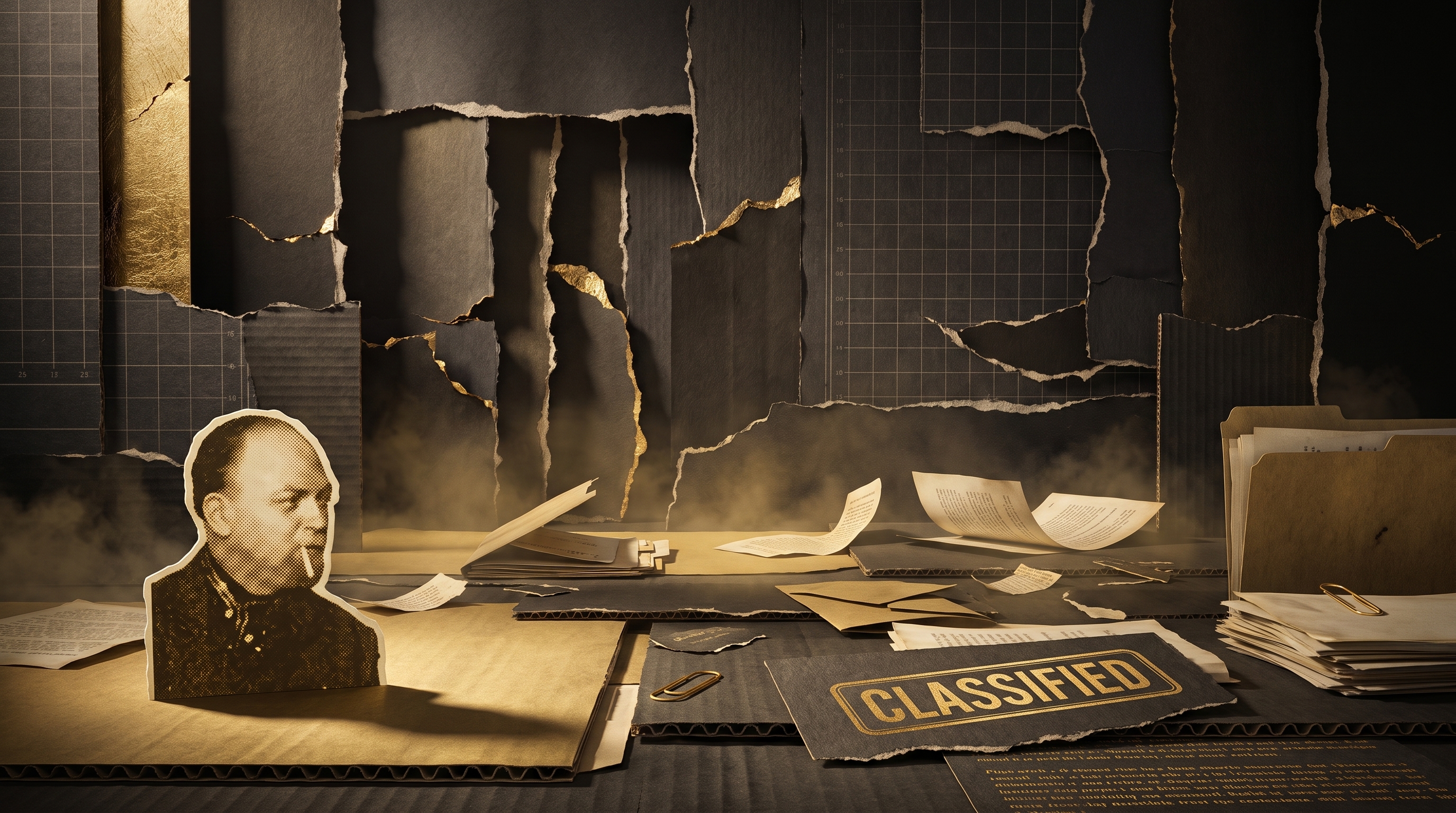
This exact image is attached to every single clip as its style reference. Every render inherits its look from here — which is why it is never regenerated without versioning to -ref_v2.
The idea
The entire world is built from physical paper and cardboard — a handcrafted theater diorama, shot as if a real camera were flying through a set built on a table. Nothing is digital, nothing is flat. Every element is an object sitting in real light, casting a real shadow.
Paper Theater is the channel's explanatory layer: every diagram, list, timeline and reveal happens here. Seedance carries the photoreal cinematic beats. The two alternate, and the alternation is the style.
Two materials, one character
| Seedance | Paper Theater | |
|---|---|---|
| Carries | Location, atmosphere, dread — the Hollywood beats | Every explanation, diagram, timeline, reveal |
| Professor Bridge | Photoreal. Present in every shot. Never speaks. | ⛔ Never appears. Seedance-only character. |
| Camera | One cinematic move per shot | Never stops. One continuous move, always. |
Cutout figures here are only ever historical subjects (with an attached public-domain reference) or anonymous silhouettes carrying no identity.
Palette
Blacks are lacquer, never gray. Gold stays rich while everything else desaturates. One muted accent per chapter — never two.
Type
| Role | Face | Use |
|---|---|---|
| H1 | Cormorant Garamond, gold caps, wide tracking | Revelation words, chapter titles, the one line that must land |
| H2 | Cormorant Garamond, gold caps | Section beats, secondary slams |
| Label | Syne, warm off-white, tight tracking | Evidence labels, dates, place names |
| Counter | Heavy Syne | Number slams |
All on-screen text is gold-stamped or printed onto a paper card — never floating digital type. Text is always quoted exactly in the prompt (≤4 words, ≤2 strings per clip); unquoted text makes the model invent gibberish.
◆ The Burn Reveal — upgraded spec
The channel's signature transition, and the handoff device into a Seedance shot. It is a combustion event, not a wipe. A straight glowing line sweeping across frame is the cheap version and is banned. Every burn must carry all eight:
- Pre-ignition. The paper browns, darkens and curls ahead of the flame — the material reacts before it catches. No instant ignition.
- Organic edge. The ember front follows the torn fiber grain — irregular, branching, faster along a tear, slower across the weave. Never straight, never geometric.
- Gold leaf reacts. Where the burn crosses gold leaf it blisters, bubbles and peels back rather than simply vanishing.
- Ash physics. Flakes lift off the burning edge and drift up through frame, catching the key light, some tumbling toward camera.
- The fire lights the room. Real moving bounce light thrown across the surrounding set — shadows swing and shorten as the front travels. This is the single biggest upgrade; a burn that doesn't light its own set reads flat.
- Reveals depth, not a layer. The hole opens onto real recessed space and the camera pushes through it. Never a flat plane behind a flat plane.
- After-glow. The char edge holds glowing and creeping for a beat after the flame front passes. Nothing snaps off.
- Smoke. Fine threads rising off the char, drifting through the key light.
Audio for a burn: paper crackle, a low combustion roar swelling underneath, ash tick, sub-hit landing on whatever is revealed.
Motion identity
The camera never stops
Every clip is one continuous move — push deeper into the diorama, pan left or right along the stage, descend toward the floor, crane back and up, track past foreground props into the back wall. One move per clip, stated once. Static locked-off cameras are explicitly banned in the negative.
Paper moves like paper
Elements never fade in. They are physical objects and must behave like it:
- Cutouts slam up through the floor
- Panels tear open; walls split apart
- Stacks collapse; slabs drop hard, throwing loose scraps outward on impact
- Paper bursts and scraps blast across frame
- Documents re-fold physically into new forms — never dissolve
- Gold leaf shatters and peels
The stagger rule
Elements never arrive simultaneously. A, then B, then C, staggered is the highest-value phrase in the system — it's what makes motion read as designed rather than generated.
Entrances start from an empty stage
Beats where elements assemble must begin from an empty or partial stage so pieces genuinely enter frame. Animating from a finished still produces jitter, not motion — this was the defect in earlier episodes.
Component vocabulary
Objects are named by role, never by appearance — the sheet already answers what things look like.
cutout card panel slab label counter thread route line pin map dossier seal stamp bundle ember front
Layers
| BG | The stage — locked, never redescribed |
| MG | Cutouts, figures, the subjects |
| FG | Cards, counters, labels, props in front |
Audio identity
Sound design only — never music, never narration. Clips sit under Bruva Bridge's voice-over; music is added in post. The world is paper, so the sound is paper:
- Tearing, sliding card stock, riffling pages
- A paper thump as a cutout lands; a soft cardboard knock
- A low room hum underneath
- Ember crackle and a swelling combustion roar for burns
- A deep sub-hit on number slams and title cards
Banned
- No music, soundtrack, score, narration, voice-over, speech or lyrics
- No flat vector look, glossy 3D render, plastic, neon, glow effects or lens flares
- No sacred geometry, circles or mandalas — retired as distracting
- No gray-blue palette, desaturated wash or white background
- No floating digital type, gibberish or warped lettering, watermarks, subtitles
- No static locked-off camera, no still frame
- No cross-fades or opacity fade-ins for entrances
- No photographic realism on figures — they stay halftone paper cutouts
How the system works
style locked once→ Prompt pack
action blocks only→ Assembly
style + shot + audio→ Clips
Omni · 16:9 · 8s
Style is written once, in the sheet. Every clip prompt contains only choreography — who enters, what it does, where it settles. No colors, no materials, no render adjectives in an action block, ever. That single discipline is what keeps 35 clips looking like one film instead of thirty-five experiments.
Sheet: MG-PAPER-THEATER · Reference: MG-PAPER-THEATER-ref.png · Model: gemini-omni-video · 16:9 · 8s · SFX only
Motion reference: Vox-style continuous-camera collage · Locked 2026-07-19 · ← back to QC index